
What Canada's Wealth Fund Debate Teaches Us About Personal Financial Planning
Canada just announced its first sovereign wealth fund. It is called the Canada Strong Fund, and the federal government is putting $25 billion into it over the next three years. The plan is to invest in energy, critical minerals, agriculture, and infrastructure. It will be run by a new Crown corporation with its own CEO and board, and Canadians will eventually be able to buy in directly.
That is a big deal. And the debate around it has been loud. Some people love the idea. Some people think it is reckless. But here is the thing: whether you support the fund or not, the conversation happening at the national level is the exact same conversation that should be happening at your kitchen table.
I am not here to tell you whether this is good policy or bad policy. I am here to tell you that the questions being asked about this fund are the same questions I ask families every week. And most families have never thought about them.
Where Is the Money Coming From?
This is the first question, and it is the most important one.
Norway is the country everyone compares us to. Norway built the most successful sovereign wealth fund in history. It is now worth over $2.2 trillion. That is roughly $340,000 for every single Norwegian citizen. But here is the detail that matters: Norway built that fund from surplus. They discovered oil in the North Sea, and instead of spending all of it, they saved a portion and invested it. The money came from revenue they had already earned.
Canada's fund is different. The $25 billion is coming from the federal budget at a time when the country is running a deficit. That does not automatically make it a bad idea, but it does change the math. It is the difference between a family investing their savings and a family borrowing to invest.
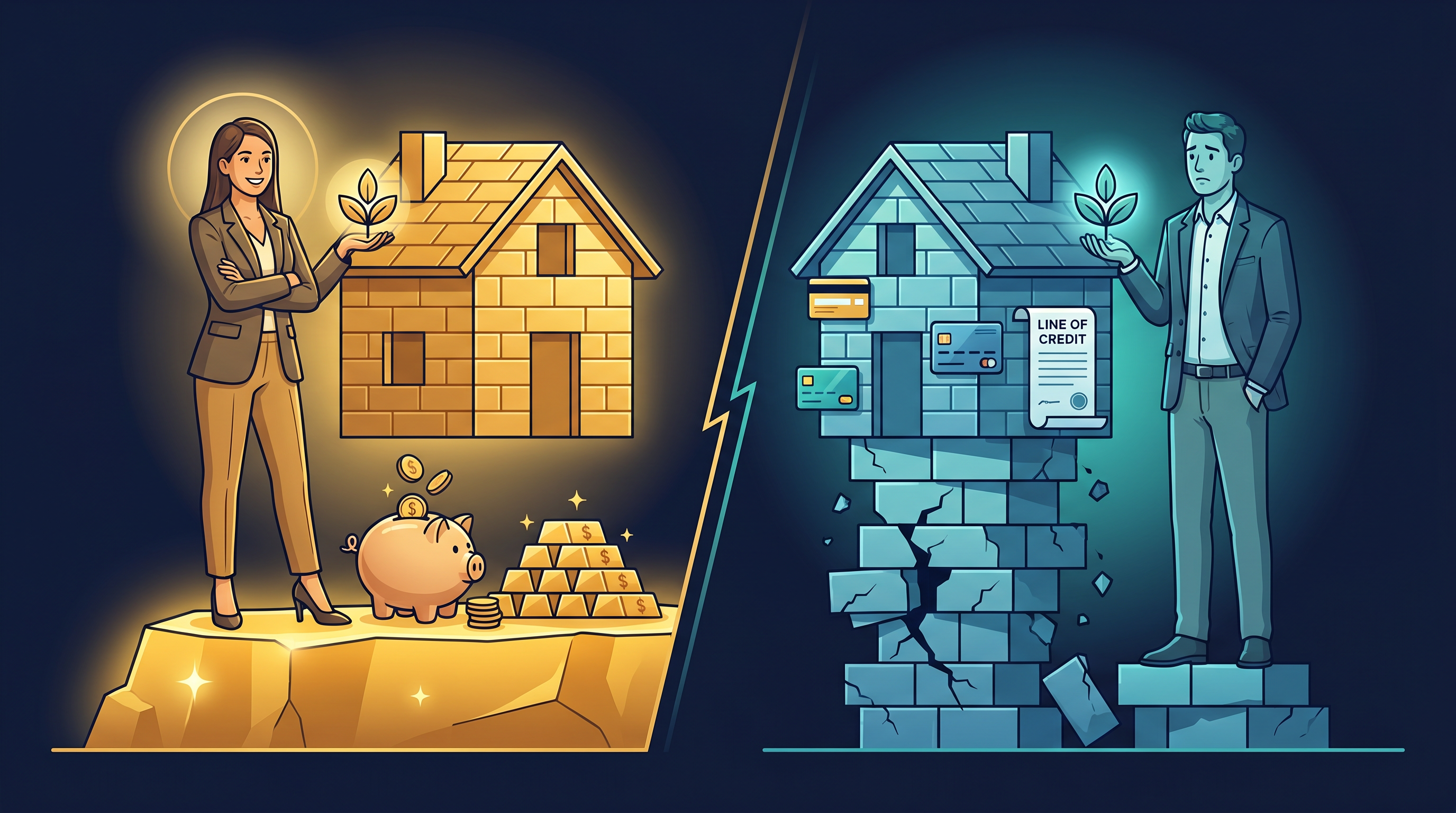
Think of it this way. Imagine two neighbours. One has been putting $500 a month into a savings account for years. She has $60,000 sitting there, and she decides to invest it. The other neighbour has no savings, but he takes out a $60,000 line of credit and puts it into the market because he believes it will grow faster than the interest he owes.
Both of them are "investing." But the risk profile is completely different. The first neighbour can survive a bad year. The second neighbour is in trouble the moment things do not go as planned.
That is the same question families need to ask themselves. Before you invest, where is the money actually coming from? Is it surplus, meaning money left over after your bills, taxes, insurance, and emergency fund are handled? Or is it money that should be doing something else first?
I see this constantly. A family wants to grow their wealth, which is a good instinct, but they are investing money that should be sitting in an emergency fund. Or they are putting money into an RRSP while carrying $18,000 in credit card debt at 20% interest. The ambition is right. The order of operations is wrong.
If your household is spending more than it earns, you do not have an investing problem yet. You have a cash flow problem. And no investment return can reliably fix a cash flow problem.
Do Not Put All Your Eggs in the Same Basket (Even If It Feels Like Home)
One of the biggest criticisms of the Canada Strong Fund is that it plans to invest primarily in Canadian projects. Norway did the opposite. Norway deliberately invested its fund outside of Norway. They did not want their national wealth tied to the same economy that was generating the revenue in the first place.
That sounds counterintuitive. Why would Norway not invest in Norway? Because they understood something that a lot of Canadian families still struggle with: concentration risk.

Here in Alberta, we know this better than anyone. I have sat across the table from families who had their income tied to oil and gas, their house value tied to the Alberta economy, their investments heavy in Canadian energy stocks, and their business revenue dependent on the same commodity cycle. When oil was at $100 a barrel, everything looked great. When it dropped, their income, their home equity, their portfolio, and their business all took a hit at the same time.
That is not bad luck. That is concentration risk. Everything was connected to the same outcome.
Think of it like a hockey team that only practices power plays. When they get a power play, they look incredible. But the moment they are at even strength or killing a penalty, they fall apart. A good team is built for all situations, not just the ones where conditions are perfect.
Your portfolio should work the same way. It is fine to own Canadian banks, Canadian energy, Canadian real estate. Those can all have a role. But if your entire financial life rises and falls with the same economy, the same interest rate, or the same commodity price, you are not diversified. You are concentrated. And concentration feels safe right up until the moment it is not.
A portfolio should not be a collection of things you like or things that feel familiar. It should be built around your time horizon, your risk tolerance, your liquidity needs, your tax situation, and what the money is actually for.
Your Family Needs Rules, Not Just Good Intentions
The Canada Strong Fund is supposed to operate at arm's length from the government. It will have an independent board and a CEO making the investment decisions. The idea is that political pressure should not drive where the money goes.
Whether that actually works remains to be seen. But the principle is sound: when real money is on the line, you need rules, not just good intentions.
Families need the same thing, even if they would never call it "governance."

Here is what I mean. Most families do not have a written set of rules for how financial decisions get made. So what happens? A market drops 15% and someone panics and sells. A coworker mentions a private investment opportunity and suddenly the plan gets bent around a single conversation. A tax bill shows up and cash has to be pulled from the wrong account at the wrong time. A couple disagrees about whether to pay down the mortgage or invest, and the argument never gets resolved, so nothing happens at all.
That is not planning. That is reacting. And reacting is expensive.
Governance in a household does not need to be complicated. It means deciding a few things in advance. How much cash do we keep available before we invest anything? How much risk are we comfortable with, and what would make us revisit that? When do we review our insurance? How do we make big financial decisions together? What would trigger a change to the plan?
When those answers exist before the pressure shows up, families make better decisions. When they do not exist, families make emotional decisions. And emotional decisions, over a 20 or 30 year time horizon, are where most of the damage happens.
Every Dollar Needs a Job
Nation-building projects like the Canada Strong Fund have multiple goals. The fund is supposed to generate financial returns, but it is also supposed to support infrastructure, strengthen supply chains, and create jobs. The challenge is that those goals can pull in different directions. The investment that creates the most jobs is not always the investment with the best return. The project that strengthens a supply chain might not be the most profitable one.
Families face the exact same tension, just at a smaller scale.
A couple wants to retire at 60, help their kids buy homes, keep an emergency fund, pay off the mortgage early, support aging parents, save for a cabin, and leave something behind. None of those goals are wrong. But if every goal is treated as equally urgent and no tradeoffs are made, the plan collapses under its own weight. The money gets pulled in too many directions, and nothing gets funded properly.
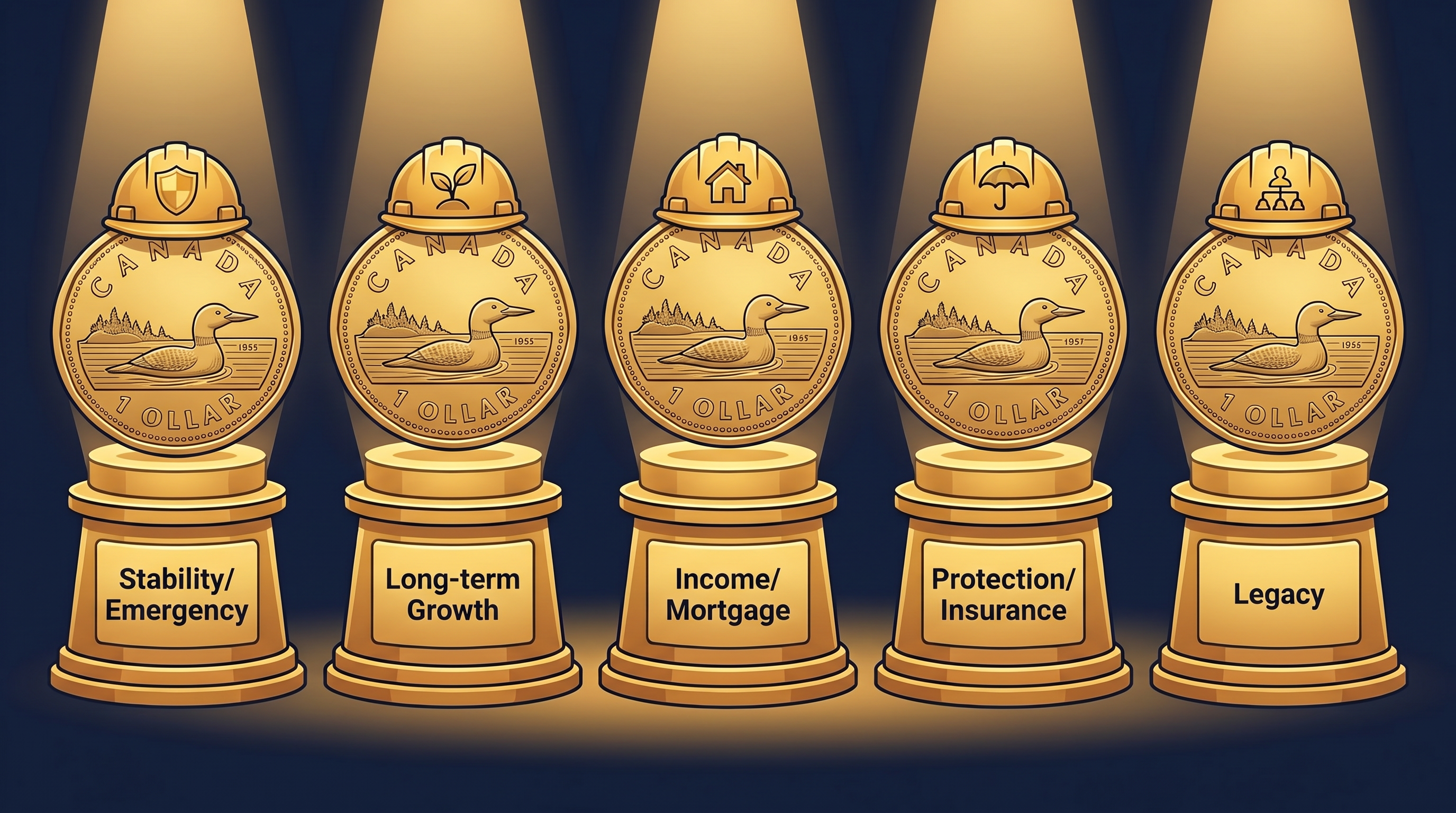
This is where the concept of giving every dollar a job comes in. Some dollars are for stability. Those sit in cash or near-cash, and they are not there to grow. They are there to keep you from making a bad decision when something unexpected happens. Some dollars are for income. Some are for long-term growth. Some are for tax efficiency. Some are for protection, meaning insurance. Some are for legacy.
When those roles are clear, the plan holds together. When they are confused, you end up asking one account or one product to do five things at once. And that is usually where disappointment starts.
Think of it like running a household. You would not use your grocery budget to pay the mortgage. You would not drain your emergency fund to go on vacation. Every dollar in your household already has a job, whether you have named it or not. A financial plan just makes those jobs explicit, so the money goes where it is supposed to go, even when life gets noisy.
Structure Beats Ambition
The Canada Strong Fund is ambitious. And ambition is not a bad thing. Wanting to build wealth, wanting to invest in the future, wanting to grow, those are all good instincts. But ambition without structure is fragile.
Norway did not build a $2.2 trillion fund because they had a strong name or a bold announcement. They built it because they had discipline, rules, diversification, and a structure that could survive bad years without falling apart.
Your family's financial plan should work the same way. It should not depend on perfect conditions. It should not require every market to go up, every government decision to go your way, or every economic forecast to be correct. It should be built with enough structure that your household can keep moving forward even when the headlines are confusing and the outcome is uncertain.
Before talking about products, returns, or market opinions, the better question is whether your financial life is actually structured to support the future you are trying to build. Because a wealth fund is not a plan. A portfolio is not a plan. A product is not a plan. A plan is the structure that tells each dollar what job it has, what risk it can take, and what it is supposed to help protect or build.
This article is for general educational purposes only and is not a recommendation to buy, sell, borrow, invest in, or avoid any specific investment, fund, security, product, or strategy. Every financial situation is different, and no strategy is suitable for everyone. Decisions should reflect your personal goals, risk tolerance, cash flow position, debt obligations, tax situation, insurance needs, time horizon, and overall financial strategy.
David Cloutier, Co-Founder Five Ridge Financial Ltd.
References
- Prime Minister of Canada, Prime Minister Carney announces the Canada Strong Fund, Canada's first sovereign wealth fund
- Department of Finance Canada, Canada Strong Fund backgrounder
- Norges Bank Investment Management, About the fund
Get notified of new articles
Subscribe to receive an email when we publish new blog posts. No spam, unsubscribe anytime.
Comments
No comments yet. Be the first to share your thoughts.
Want to Know Where You Stand?
Our Financial Snapshot gives you a clear picture of your current position and helps identify what to focus on next.