
What a Potential SpaceX IPO Can Teach Investors About Hype, Liquidity, and Suitability
What a Potential SpaceX IPO Can Teach Investors About Hype, Liquidity, and Suitability
Category: Investing | Behavioural Finance | Risk Management Read time: 12 minutes | Audio version available
Important note: This article is for educational purposes only. It is not investment, tax, legal, accounting, or insurance advice. It is not a recommendation to buy, sell, hold, short, or avoid SpaceX or any other security. The right investment decision depends on your goals, time horizon, liquidity needs, tax situation, risk tolerance, risk capacity, and overall financial plan. This strategy or discussion is not suitable for everyone.
The issue is not whether SpaceX is impressive. The issue is whether the investment terms are suitable.
SpaceX is one of the most important private companies of the last two decades. Its launch business changed the economics of access to space. Starlink has built a global satellite internet network with millions of subscribers. The company has also become deeply tied to defence, communications, artificial intelligence infrastructure, and Elon Musk's broader group of companies.
That does not automatically make a potential IPO suitable for every investor.
A strong company can still be a poor investment at the wrong price. A visionary founder can still create governance risk for minority shareholders. A business with real operating strengths can still come public with a valuation that assumes years of excellent execution. A heavily promoted IPO can still leave late buyers providing liquidity to earlier holders.
That is the core risk Canadian investors should understand. A SpaceX IPO may not simply be a chance to "get in early." For many retail investors, it could be the opposite: a chance to buy only after much of the early wealth creation has already happened in private markets.
A liquidity trap, in this context, is not a prediction that a stock must fall. It is a structure where public investors are drawn into a popular investment at a high valuation while earlier private holders, employees, founders, or institutions receive a path to liquidity. The trap is behavioural as much as financial: investors feel they are buying opportunity, but they may actually be absorbing valuation, volatility, and future selling pressure.
What is being reported about the IPO
SpaceX filed an amended Form S-1 with the U.S. Securities and Exchange Commission on June 3, 2026. The filing describes an offering of 555,555,555 Class A common shares at an expected IPO price of $135 per share, with an application to list on Nasdaq and Nasdaq Texas under the ticker symbol SPCX. [1]
CNBC reported that the fixed $135 price implies an anticipated market capitalization of approximately $1.77 trillion. It also reported that SpaceX is targeting a retail allocation of roughly 30 percent of the IPO, compared with a typical retail IPO allocation of about 5 percent to 10 percent as cited by Fidelity. [2] Reuters separately reported that SpaceX had reportedly earmarked as much as $22.5 billion of the offering for retail investors and that demand had become one of the major FOMO trades of the year. [3]
| Reported feature | Why it matters for investors |
|---|---|
| Expected IPO price of $135 per share | A fixed price reduces the usual price-discovery process that happens during a traditional IPO range-setting period. |
| Approximately $1.75 trillion to $1.77 trillion valuation | The entry price already assumes a very large business outcome, leaving less room for disappointment. |
| Roughly 30 percent targeted retail allocation | Heavy retail participation can increase volatility if buyers are motivated by scarcity, loyalty, or day-one trading hopes. |
| Dual-class voting structure | Public Class A shareholders may own economic exposure without meaningful control over governance. |
| Staggered lockup releases | Future share supply can enter the market in waves, which may pressure the stock even if the business remains strong. |
The numbers are large enough that the IPO should be viewed as a market-structure event, not just a company listing. A $75 billion offering can pull liquidity from other holdings. If retail investors want to participate but do not have idle cash, they may need to sell other investments first.
Yahoo Finance, summarizing 24/7 Wall St. and CNBC discussion of BNP Paribas analysis, reported a thesis that retail participation could create selling pressure in crowded semiconductor and leveraged Nasdaq products as investors raise cash for allocations. [4] That thesis is already showing early signs of playing out. In the week ending June 5, the Nasdaq-100 fell 4.5 percent. The iShares Semiconductor ETF dropped 12 percent from its June 3 closing high. The VIX surged 39.7 percent in a single session. Even Bitcoin fell below $60,000 for the first time since September 2024, with the iShares Bitcoin Trust ETF recording $1.24 billion in outflows in the first week of June alone. [7]
Demand for the offering reportedly exceeded $250 billion, more than three times the available supply. Multiple institutional investors submitted orders of approximately $10 billion each. BNP Paribas estimated that retail and passive investors might sell as much as $50 billion of other stocks to fund their SpaceX allocations. [7] That does not mean the thesis will be fully correct, but it is a useful reminder that large offerings can affect more than the company going public. The liquidity vacuum extends well beyond a single ticker.
The business is not one simple business
A common retail mistake is treating a famous company name as though it represents one clean business model. SpaceX is not just rockets. Based on the company's filing, it includes Space, Connectivity, and AI segments. [1]
The differences between those segments matter enormously.
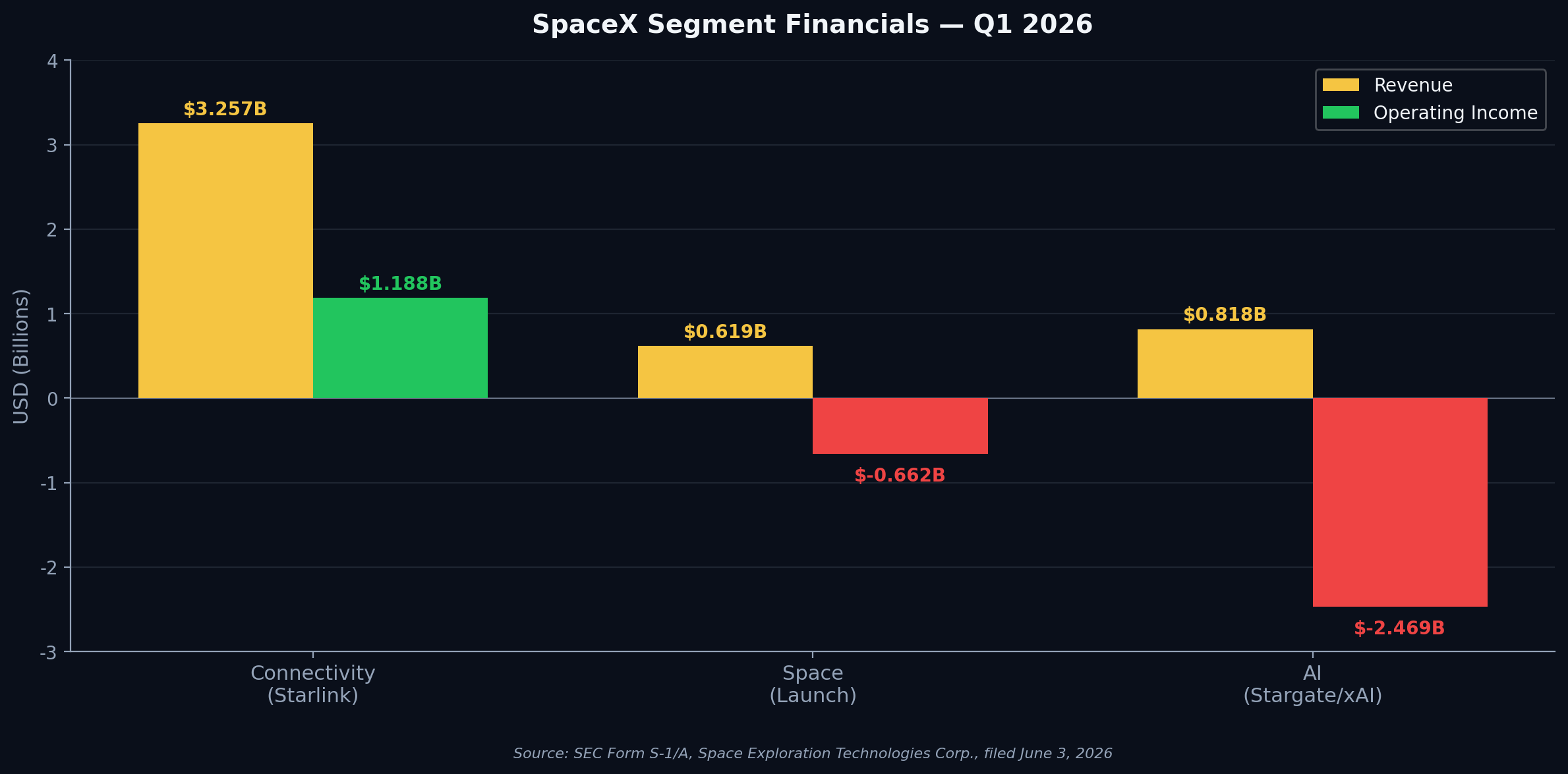
The Connectivity segment, primarily driven by Starlink, generated $3.257 billion of revenue and $1.188 billion of operating income in the first quarter of 2026. The Space segment generated $619 million of revenue and a $662 million operating loss over the same period. The AI segment generated $818 million of revenue and a $2.469 billion operating loss in the first quarter alone. For 2025, the AI segment reported a $6.355 billion operating loss. [1]
The filing also states that the AI segment had $7.723 billion of capital expenditures in the first quarter of 2026 and $12.727 billion in 2025. [1] That matters because the investment case may no longer be simply about rockets and Starlink. It may also depend on AI infrastructure, data centres, X, Grok, orbital computing, and future technologies that remain commercially uncertain.
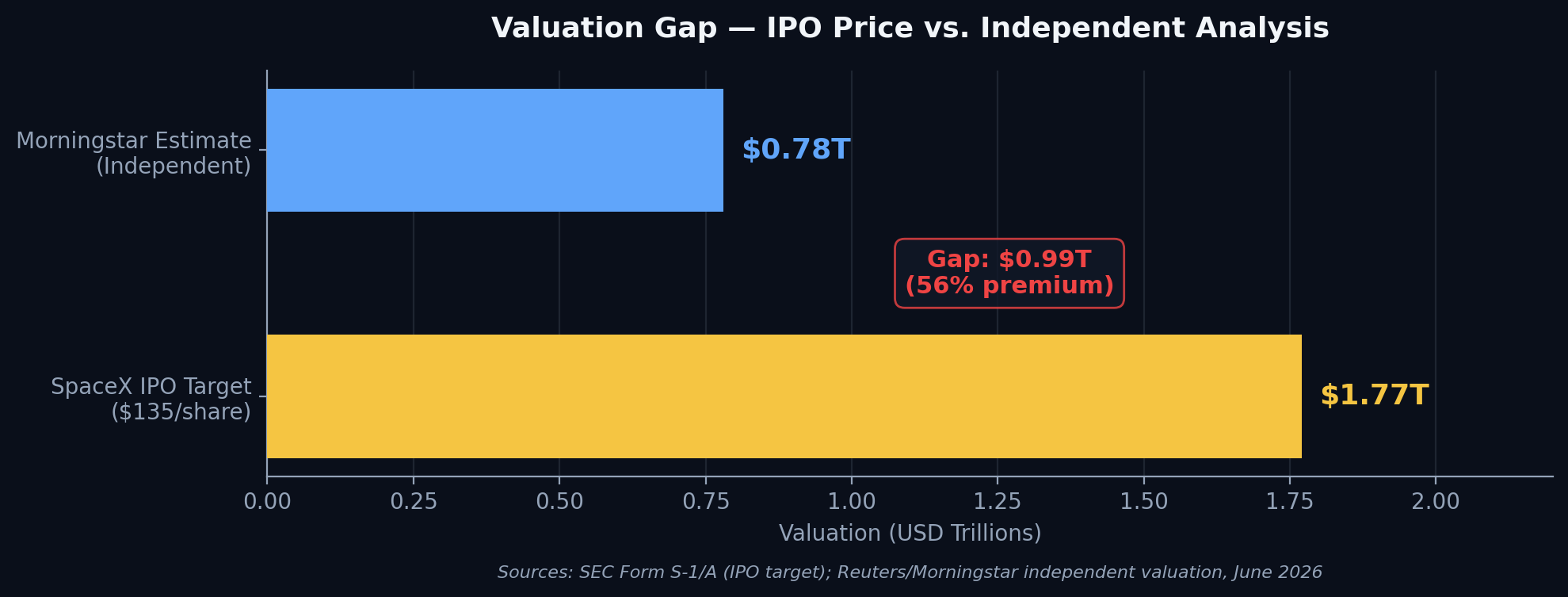
Morningstar analysts, according to Reuters, valued SpaceX at $780 billion, less than half of the reported IPO target. The concern was not that the company has no value. The concern was that the AI business has unclear economics, significant competition, and reliance on untested ideas such as orbital data centres. [5]
For investors, the relevant question is not whether SpaceX is interesting. It is whether the price being paid leaves enough margin for error.
The liquidity-trap risk
The most dangerous word around a famous IPO is "early." Retail investors often feel that buying an IPO means getting in before everyone else. In many modern mega-IPOs, that is not accurate.

By the time a large private company reaches the public market, venture investors, employees, founders, private funds, sovereign funds, institutions, and secondary-market buyers may already have captured years of private appreciation. Public investors may still do well, but they are not necessarily entering at the beginning of the story. They may be entering at the point where earlier owners finally receive a regulated, liquid public market.
This is why the lockup schedule matters. The SpaceX filing says only a limited number of shares will be available for sale shortly after the offering because of contractual and legal restrictions. However, it also describes substantial future releases of restricted shares. The schedule includes potential releases of hundreds of millions of shares after 70, 90, 105, 120, 135, and 180 days, with further large releases tied to quarterly results and an eventual release of up to 6.4 billion shares held by Elon Musk after 366 days. [1]
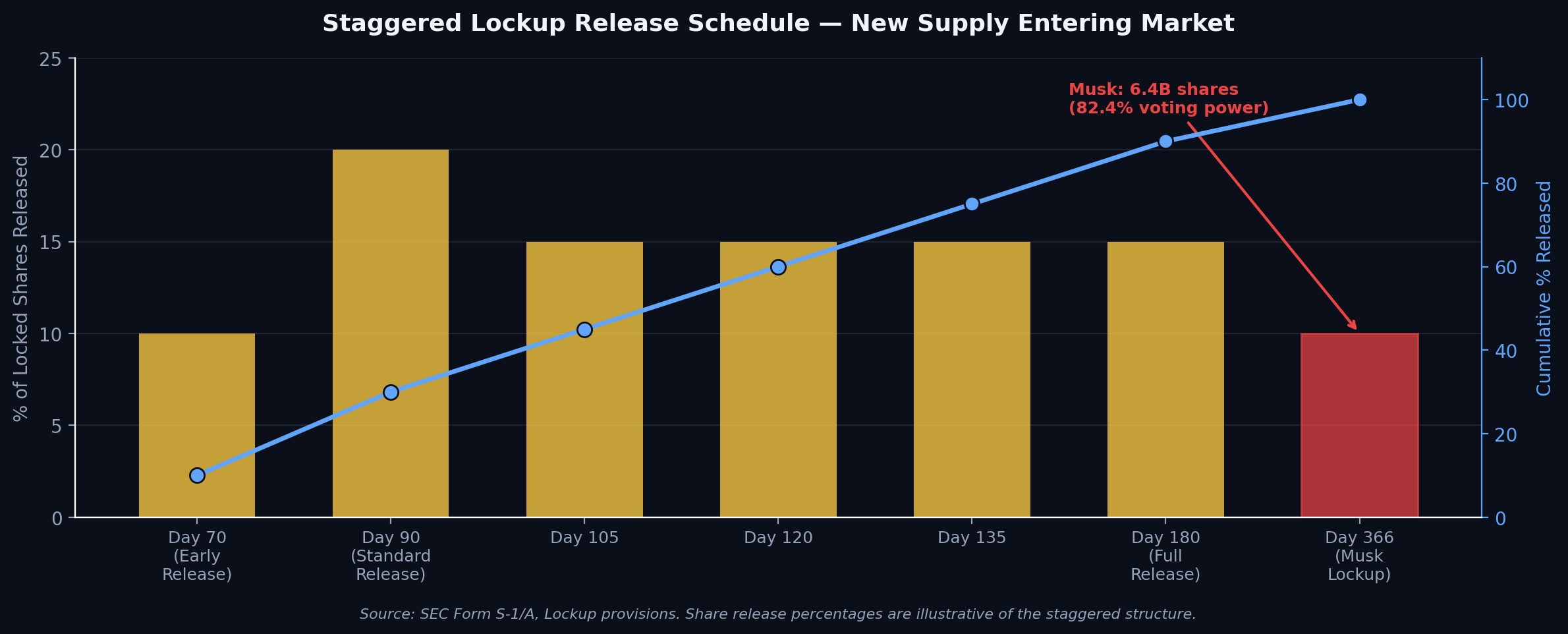
SpaceX's prospectus states that "sales of a substantial number of shares of our Class A common stock in the public market after such restrictions lapse, or the perception that those sales may occur, could adversely affect the prevailing market price" of the stock. [1]
This is not a criticism of insiders wanting liquidity. Employees and early investors often accept years of illiquidity and risk. The concern is that public buyers need to understand the mechanics. If the early trading float is limited, demand can drive the share price upward. Later, as more shares become available, the market has to absorb additional supply. If enthusiasm weakens, valuation expectations change, or broader markets decline, that supply can matter.
A liquidity trap can develop through five linked steps. First, a famous company creates scarcity and emotional demand. Second, retail investors chase access because they believe the IPO is a once-in-a-generation opportunity. Third, a limited early float can create strong initial price action. Fourth, future lockup releases increase supply. Fifth, late buyers may find themselves holding an expensive, volatile security while earlier holders have more flexibility to sell.
None of this means the stock must perform poorly. It means the investment has to be assessed on structure, valuation, rights, and portfolio fit, not just admiration for the company.
Voting control is another form of risk
The filing describes a dual-class structure. Each Class A share has one vote, while each Class B share has 10 votes. Under the assumptions in the prospectus, Elon Musk would hold approximately 82.4 percent of the voting power after the offering. [1]

That creates a clear distinction between economic exposure and control. Public investors may participate in upside and downside, but they may have limited influence over board composition, governance, compensation, related-party decisions, or major strategic direction.
The filing also states that SpaceX will be a "controlled company" under Nasdaq rules and intends to rely on exemptions from certain corporate governance requirements. [1] That can include exemptions related to independent directors, nominating committees, and compensation committees. Again, this is disclosed. The problem is not necessarily the existence of the structure. The problem is buying without understanding it.
| Investor question | Why it matters |
|---|---|
| What class of shares would you own? | Class A shares may provide economic exposure but limited voting influence. |
| Who controls the company after the IPO? | Control affects governance, strategic decisions, and accountability. |
| Are related-party transactions material? | Interconnected companies can create complexity when one founder controls multiple businesses. |
| Are you being compensated for weak governance rights? | A high valuation with limited governance rights may reduce the margin of safety. |
In a diversified portfolio, governance risk may be acceptable if position sizing is modest and the investor understands the tradeoff. In a concentrated retail position, governance risk can become a serious planning issue.
Why Canadian investors should slow down
Canadian investors do not need to turn every major U.S. IPO into a portfolio decision. Access does not equal suitability. Excitement does not equal risk capacity. Brand recognition does not equal a plan.
The Canadian Securities Administrators' Client Focused Reforms are built around the concept that clients' interests come first when registered firms and advisers provide investment advice or trade in securities. [6] The CSA also states that firms and advisers must take reasonable steps to understand securities they purchase, sell, or recommend, and must document key KYC information such as risk tolerance and financial ability to withstand losses. [6]
The CSA explains that advisers must record a client's "risk tolerance and your financial ability to withstand losses," often referred to as risk capacity, and that these changes are intended to result in more suitable investment portfolios. [6]
That distinction is important. A client may have high risk tolerance but low risk capacity. For example, a 35-year-old incorporated professional with strong cash flow, no high-interest debt, and a long time horizon may be able to withstand a speculative position better than a family using near-term savings for a home purchase, tax bill, business reserve, or parental leave. The same investment idea can be acceptable for one household and unsuitable for another.
Suitability is not just about whether an investment is good. It is about whether it fits the investor.
A practical suitability checklist before chasing a high-profile IPO
Before any Canadian investor considers a high-profile IPO, the first step should be a written suitability check. This does not need to be complicated, but it should be honest.
| Question | Poor answer | Better answer |
|---|---|---|
| Why do you want to buy it? | "Everyone is talking about it." | "I understand the valuation, risks, and role it would play in my portfolio." |
| What percentage of your investable assets would it represent? | "I have not calculated that." | "It would remain within a predetermined speculative allocation." |
| What would you sell to fund it? | "Whatever has gone up the most." | "I understand the tax, concentration, and opportunity-cost implications." |
| Can you tolerate a 50 percent decline? | "It probably will not happen." | "If it happened, it would not affect my financial security or near-term plans." |
| Do you understand the voting structure? | "I just want exposure to SpaceX." | "I understand that public Class A investors may have limited governance influence." |
| Do you understand lockup releases? | "No." | "I know future supply may enter the market in waves." |
| Is this part of your plan or a reaction to scarcity? | "I do not want to miss out." | "It fits within a documented strategy and position limit." |
This checklist matters because IPOs are often sold emotionally. Scarcity, founder loyalty, media coverage, and day-one price action can make investors feel like speed is more important than judgment. In planning, speed is rarely the main advantage. Process is.
The better lesson

The SpaceX IPO discussion is useful because it forces investors to separate three things that are often confused.
First, SpaceX may be an exceptional operating company in some areas. Second, the IPO may still be priced aggressively. Third, even if the stock eventually performs well, it may still be unsuitable for a particular investor because of concentration, liquidity needs, tax exposure, time horizon, or risk capacity.
That is the part worth taking seriously. The question is not, "Is SpaceX exciting?" It clearly is. The better question is, "At this price, with this structure, with these risks, and inside my actual financial life, does this make sense?"
For most families and incorporated professionals, the answer should not be reached through a headline, a social media clip, or a brokerage app notification. It should be reached through a planning process that accounts for emergency reserves, debt, insurance protection, tax obligations, retirement contributions, business liquidity, education savings, estate planning, and portfolio concentration.
A high-profile IPO can be a useful case study. It should not become a substitute for a plan.
Final thought
The risk with a potential SpaceX IPO is not that investors are interested in a remarkable company. Interest is reasonable. The risk is that retail investors mistake access for opportunity, scarcity for value, and public listing for early entry.
If you are considering any concentrated investment, especially one attached to a major media cycle, slow the decision down. Ask what role it plays in your plan, what you would sell to fund it, what loss you could withstand, and whether the expected return properly compensates you for valuation, governance, liquidity, and behavioural risk.
The strongest investors are not the ones who react fastest to a headline. They are the ones who know what they own, why they own it, how much they own, and what would cause them to change course.
References
[1] SEC, Space Exploration Technologies Corp. Form S-1/A, filed June 3, 2026 [2] CNBC, "SpaceX IPO explained: The price is set, but retail allocation still up in the air" [3] Reuters, "How can retail investors buy shares in SpaceX's IPO?" [4] Yahoo Finance, "Wall Street Bank Warns SpaceX IPO Could Trigger Large Sell-Off in Popular Semiconductor Stocks" [5] Reuters, "Morningstar values SpaceX at $780 billion, half its IPO target" [6] Canadian Securities Administrators, "Putting Investors First: How Client Focused Reforms Affect You" [7] Glitchwire, "The SpaceX IPO Is Creating a Liquidity Vacuum That Extends Far Beyond Wall Street," June 11, 2026 [8] Barron's, "Review and Preview: The AI Rally Keeps Unwinding," June 10, 2026
Get notified of new articles
Subscribe to receive an email when we publish new blog posts. No spam, unsubscribe anytime.
Comments
No comments yet. Be the first to share your thoughts.
Want to Know Where You Stand?
Our Financial Snapshot gives you a clear picture of your current position and helps identify what to focus on next.